Showing posts with label age related hearing loss. Show all posts
Showing posts with label age related hearing loss. Show all posts
Tuesday, July 12, 2011
Hearing Testing is Tossing Out Veteran Police
The NYT is reporting on the NYC police department and it's policy on hiring: if you can't pass a hearing test you will not be hired as a police officer. The department has allowed officers to wear hearing aids and even pay for them at times but this is not the official policy. In 2009 they started enforcing a ban on hearing aids effectively pushing out the older officers who then would tell others not to wear them to work.2 have already filed a complaint with the EEOC stating that the policies are discriminatory.

Friday, February 18, 2011
Will Hearing Aids Help Prevent Dementia?
 New research has shown that people who are hard of hearing have increased odds of developing dementia.The research however, does not show a direct correlation between cause and effect. There is hope that perhaps as more people use hearing aids, it can stop the tide of dementia.
"Dementia is devastating, and the prevalence doubles every 20 years," said Dr. Frank R. Lin, an ear surgeon at Johns Hopkins University in Baltimore, whose findings appear in the Archives of Neurology.
"There are some studies showing that if you can delay dementia onset by just one year, you would decrease the prevalence of dementia by more than 10 percent in 2050."
Monday, January 24, 2011
Hearing Aid Questions
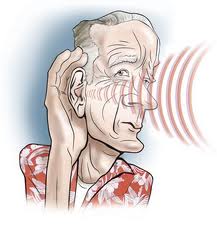
QUESTION: My doctor recently told me that I need a hearing aid. My first thoughts were of the large, clumsy hearing aid my grandfather wore. I'm sure there must be better options. Over time, some hair cells in the inner ear grow old, die and are not replaced. When hair cells die, the electrical messages of sound don't travel to the brain as well as they should.
ANSWER: If you're like so many members of the boomer generation, your problem may be presbycusis, or age-related hearing loss. Presbycusis is the leading cause of hearing impairment and affects most people as they age.The good news for people with age-related hearing loss is that, like cell phones, computers and televisions, hearing aids have benefited from the digital revolution. As a result, hearing aids are smaller and have better sound quality than ever before. And as the technology continues to evolve, hearing aids are gaining new capabilities, including wireless connectivity to cell phones, televisions and MP3 players.Even with these impressive advances, all hearing aids have the same primary purpose: to make sound louder. They have the same basic components, and most run on batteries. They contain at least one microphone that picks up sound and converts it into electrical signals.These signals are transmitted to an amplifier, which boosts their strength and alters the sounds. The amplified electrical signals then travel to a receiver, a small loudspeaker hat converts the electrical signals back into sound waves, and channels them into the ear.
The first generation of hearing aids only amplified sounds by a few decibels. By contrast, hearing aids today can boost sound by as much as 80 decibels -- roughly the difference between a whisper and a car horn. That's why it's extremely important to find a reputable hearing aid professional, often called a dispenser, who will adjust the volume properly so it's loud enough to meet your needs but not so loud as to be harmful.The hearing aid style and circuitry that you choose depend on many things. A prime consideration, of course, is the nature of your hearing loss, its cause and its severity. Your audiologist or hearing instrument specialist will make recommendations based on your audiogram.For example, if you have severe hearing loss, you may need a larger hearing aid. Although this is gradually changing, small hearing aids are typically too small to contain circuitry powerful enough to help someone with more than moderately severe hearing loss.Even if you have a mild to moderate degree of hearing loss, the smallest hearing aids may not be an option for you. If you are prone to an excessive buildup of earwax or to ear infections, small hearing aids may not be the best choice because they are easily damaged by earwax or draining ear fluid.
Finally, you may want the capability to reduce some types of background noise and boost the sound frequencies you have the most trouble hearing; these optional features are not always available in very small hearing aids.
Subscribe to:
Posts (Atom)